
How to Cut Your Office AC Energy Bill by 15-30% Without Rewiring or Replacing a Single Unit
A practical guide to fixing the most common causes of wasted air conditioning energy in Indian offices — with a real deployment case study.
Why Air Conditioning Dominates Your Office Energy Bill
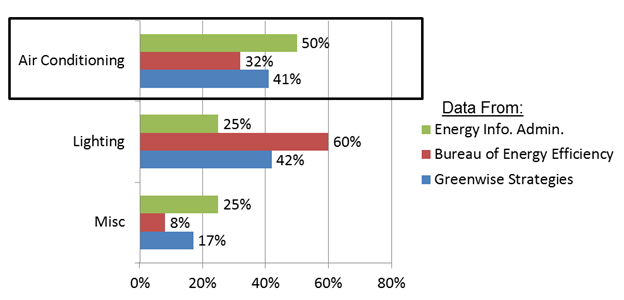
Every office runs on a mix of lighting, computers, and other equipment — but air conditioning is almost always the single largest line item on the energy bill, typically accounting for 35-50% of total office energy consumption.
Most offices don’t run one AC system — they run several, often different ages, brands, and types (window units, split units, and VRV/VRF systems) scattered across cabins, open seating areas, server rooms, and conference rooms. Each one is usually controlled independently — by an individual’s IR remote, or in the case of older window units, directly at the power supply.
That decentralization is exactly where the waste creeps in.
5 Ways Offices Waste AC Energy Without Realizing It
Studies of typical commercial deployments show that 10-30% of the energy consumed by office ACs is wasted on cooling that nobody is actually using. Here’s where it comes from:
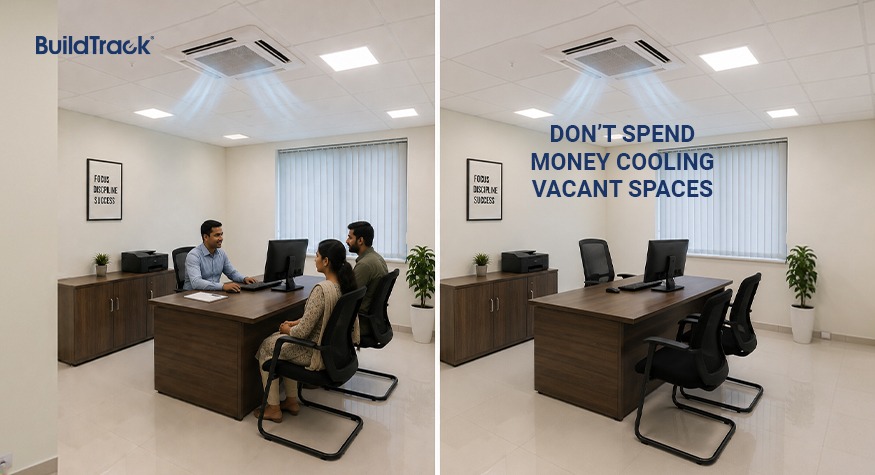
ACs Left Running in Vacant Rooms
Without occupancy detection, a conference room or cabin AC keeps cooling long after the last person has left.
No After-Hours Scheduling
ACs that aren’t tied to a schedule frequently stay on well past closing time, cooling an empty office overnight.
Set Points Below the Efficient Range
Every degree below 24°C increases AC power consumption by roughly 3-5%. Multiply that across dozens of units set to 18-20°C by individual preference, and the losses compound fast.
Multiple Units Fighting Each Other in One Space
Without room-level temperature monitoring, it’s common for two or three ACs to run in the same space when one would do the job — because no single system is coordinating them.
No Control During Peak Tariff Periods
Most offices have no easy way to shut down or throttle ACs during peak electricity rate windows, even though that’s when the cost per unit of cooling is highest.
Why Most Offices Don’t Fix This
The waste is well understood — so why does it persist? In our experience working with facility teams, it usually comes down to two assumptions:
- “Our office is already finished — we can’t run new wiring for a smart system.”
- “Our existing ACs are too old / from too many brands to bring into one system.”
Both are reasonable concerns, but neither is actually a blocker. Modern retrofit control layers — wireless or using a single existing wire loop — can bring a mixed fleet of ACs from different brands and vintages under one system without re-wiring or altering the finished aesthetics of the space.
Case Study: Centralizing AC Control at a Medical College in Kolkata
To make this concrete, here’s how BuildTrack solved this exact problem for R.G. Kar Medical College, a medical school and hospital in Kolkata.
The challenge: The college’s Public Works Department (PWD) was responsible for operating and maintaining a large, mixed fleet of air conditioners — O-General, Mitsubishi, and Hitachi units — spread across ground, first, and second floor wards, labs, and doctors’ rooms. PWD needed a way to monitor and control all of them centrally, without replacing the existing hardware.
The deployment:
- A wired system using an RS-485 loop, connected to a local BuildTrack server — a single cable loop carries both power and communication to every node.
- IR nodes with CT (current transformer) input on each AC, so the system can both send commands and verify actual operating current — not just assume a command worked.
- Power nodes with manual override, so on-site staff retain direct physical control alongside the automated system.
- Temperature and humidity sensors placed across the wards and labs to drive occupancy- and condition-based control rather than blanket scheduling.
- A dashboard and mobile app giving facilities staff a single view of every AC’s status, temperature, and fan speed — down to individual bed and room level — plus a full activity log of every remote command issued, with location and timestamp.
The result: PWD staff can now view, group, schedule, and override every air conditioner in the building from one interface — regardless of brand — with full visibility into runtime and consumption for reporting.
This is the same underlying model behind the general guidance above: retrofit control at the node level, one communication backbone, and centralized visibility — rather than assuming a mixed, finished-building AC fleet has to be replaced or rewired to be brought under control.
What a Retrofit AC Control System Actually Delivers
Across deployments like this, the levers that reduce consumption are the same ones listed earlier in this article, now automated:
- Scheduling — ACs turn off automatically outside working hours, no manual step required.
- Auto ON/OFF based on occupancy — tied to presence rather than habit.
- Set-point correction — bringing outlier units back to an efficient range.
- Overcurrent shutoff — units drawing current beyond their rated limit are flagged and can be shut down, addressing a fire-safety risk alongside the energy waste.
For a typical 1.5TR office AC, average daily consumption runs around 12.5 kWh. Applying scheduling, occupancy control, and set-point correction across a fleet like this typically reduces that consumption by 15-30%, with a payback period of 6-15 months — figures consistent with BuildTrack’s two-time CII Excellence in Energy Management Award and its 4-star Bureau of Energy Efficiency (BEE) rating.
Getting Started
You don’t need to gut a finished office or replace working AC units to fix this kind of waste. Start with an audit of what’s actually running against who’s actually in the room — that gap is usually where the first 10-15% of savings is sitting, before any hardware conversation even begins.












This is very nice information. Thanks for sharing this informative information about the home automation.