2 important messages to take away:
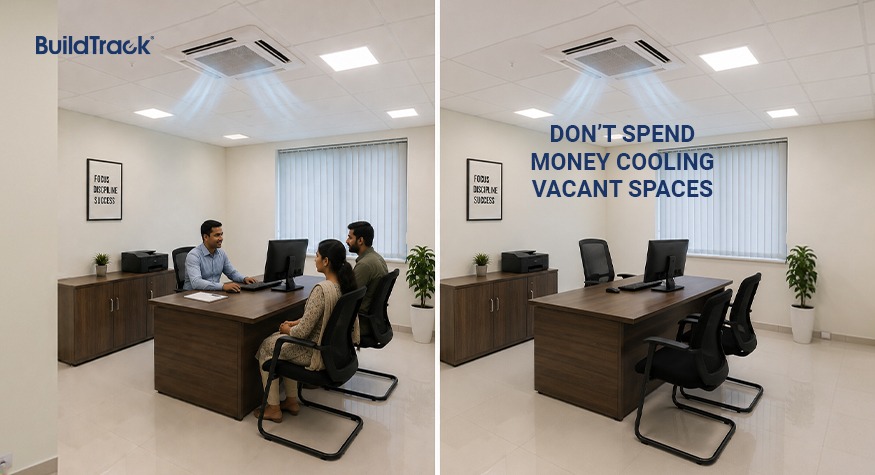
- If your AC’s are operating without people in that space, you are wasting energy and money !
- In most cases you earn the equivalent of a 25% compounded return for Occupancy Control solutions! Which investment gives you that kind of returns?
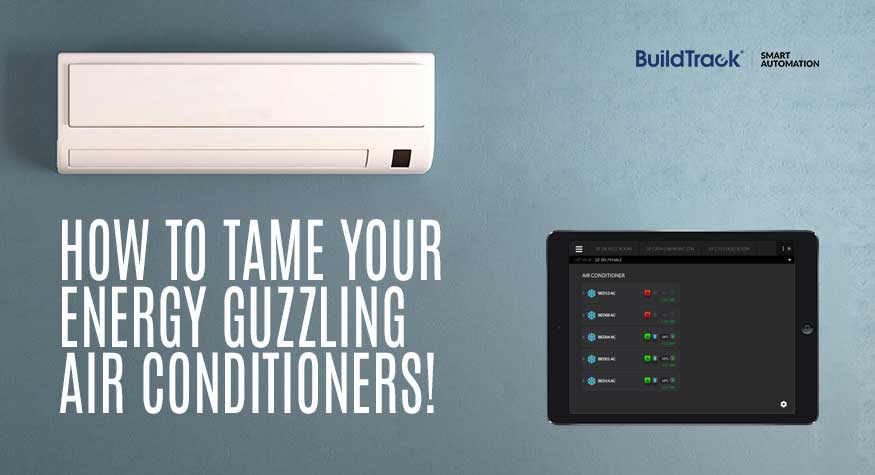
As enterprises continuously look for ways to optimize operational expenses and scale sustainable business practices, energy costs offer one of the biggest opportunities. In a typical commercial office, workspace, or retail environment, air conditioning systems represent the single largest consumer of electricity—accounting for a staggering 40–50% of total energy consumption. Yet, despite this heavy load, there is substantial inefficiency that can be addressed. Executive cabins, private meeting rooms, conference halls, and desk areas are routinely left empty during lunch breaks and meetings for minutes to hours. Traditional air conditioning systems, continue to run blindly in these vacant spaces, driving up power bills and compounding carbon footprints.
Replacing existing commercial air conditioning assets to upgrade efficiency is capital-intensive, logistically complex, and highly disruptive to daily business operations. Fortunately, enterprises do not need to replace their hardware to achieve dramatic savings. By deploying smart retrofit Occupancy Control solutions, organizations can capture immediate savings.
ECSBC 2024, i.e. Energy Conservation and Sustainable Building Code 2024, issued by the Bureau of Energy Efficiency (BEE) in India to mandate energy efficiency and broaden sustainability standards in buildings heavily emphasizes OCCUPANCY CONTROL for air conditioning (HVAC) systems to eliminate energy waste in unoccupied or intermittently used spaces. Since HVAC typically consumes the largest portion of energy in commercial buildings, it offers the most opportunity for conservation.
Occupancy Controls works to harvest vacancy related energy waste
At its core, occupancy control is designed to automatically capture energy savings by shutting down the air conditioner whenever the served space is vacant. When an AC is turned off in a vacant room, indoor temperatures gradually rise. Upon a user’s return, the system restarts and also expends some additional energy to cool the space back down to the set temperature (such as the 24°C baseline recommended by the Bureau of Energy Efficiency). Because of this “recovery energy penalty”, 100% of the energy consumed during the vacancy period cannot be entirely saved but a large portion of it can be saved.
Detailed field assessments reveal that approximately 50–80% of the energy that is otherwise wasted during vacancy periods can be successfully conserved. To put this into perspective, consider a standard 10-hour corporate workday (running from 8 a.m. to 6 p.m.). If a room or private cabin remains vacant for just one hour during lunch or through accumulated short meetings, the vacancy period accounts for 10% (1/10hrs) of the daily operating schedule. While total daily energy consumption may not drop by the full 10% due to the thermal recovery curve, it can consistently and reliably be reduced by 5 to 8% which is a considerable amount. Also, as people move out of their space for meetings and other reasons, they might be away from their space considerably longer than the example. The savings correspondingly increases.
Key Elements of the Retrofit Solution
Occupancy Control platforms—such as those pioneered by BuildTrack, and awarded by CII for innovation —are engineered to integrate smoothly into finished commercial interiors without requiring structural changes or rewiring. The system consists of:
- Occupancy Sensors: Depending on room layout and sensitivity requirements, systems utilize either battery-powered Passive Infrared (PIR) sensors (offering multi-year battery life) or externally powered millimeter-wave presence sensors to accurately detect human activity.
- Smart IR Transmitters & Universal Controllers: Compact nodes attached near the indoor unit or connected to compatible thermostats, relay ‘ON’ and ‘OFF’ commands based on communication it receives from the Occupancy Sensor.
- Energy Data Monitoring: This requires WiFi connectivity and is hence an optional, but highly relevant IoT based monitoring feature. It provides transparency to the working of the entire system and measures the periods over which the AC was turned OFF and the energy consumption of the AC. Smart app interfaces and cloud dashboards provide facility managers with granular visibility into AC runtimes, operational states, and energy consumption metrics across multiple zones, enabling exceptional data for conducting energy audits.
Maximizing ROI and Bottom-Line Impact
For business owners and real estate leaders across India, implementing retrofit Occupancy Control creates a economic benefit that can exceed other investment opportunities especially as commercial energy rates keep rising. The system operates via two main strategies: automatically cutting power after a short delay upon detecting vacancy, and offering the option of intelligent management, where the system restarts at an optimal preset temperature when occupants return. It can also operate on ‘vacancy mode’ which differs from occupancy mode, because the AC does not automatically turn ON based on occupancy but it turn OFF based on vacancy. The vacancy mode allows the user to turn on the AC as they desire after their return, so that on cooler days some users who do not prefer to use ACs can avoid doing so.
Because air conditioning loads scale with tonnage, larger commercial spaces and higher-capacity systems yield even greater financial savings, translating into quick payback periods. By transforming invisible, passive energy waste into active bottom-line savings across any type of AC system :
- Fixed-speed and inverter split ACs
- Cassette ACs
- VRF indoor units (Variable Refrigerant flow)
- Ductable split units
- VAV boxes (Variable Air Volume)
- FCU (Fan Control Units)
Any situation that has vacancy in a space during the day can achieve meaningful corporate savings and sustainability goals related to their ESG compliance.
Read more details on this topic. Download our White Paper